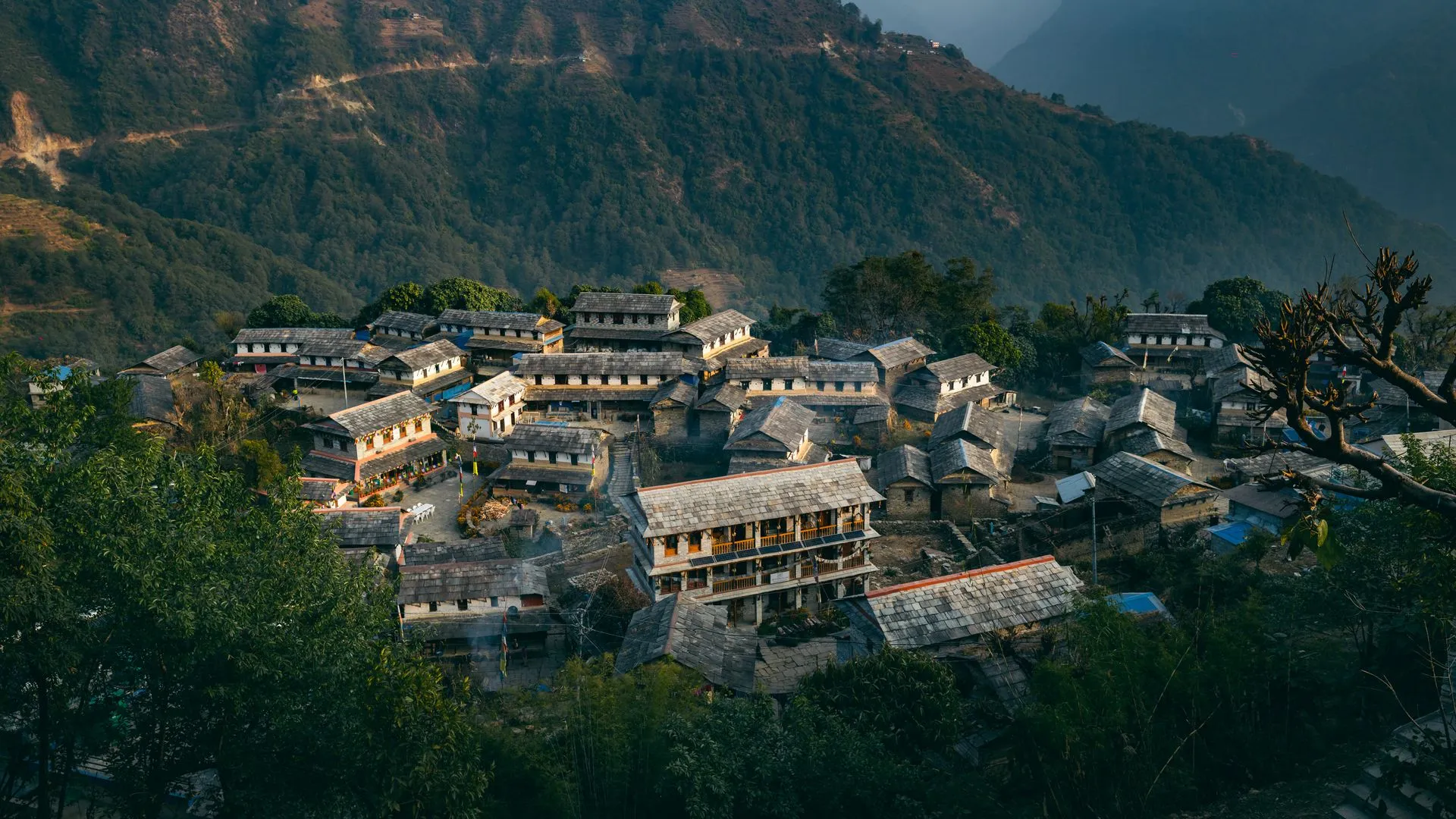
Our origins
Where the Chhantyal first came from is not settled history — our beginnings survive more in story than in written record, and scholars frankly call them a mystery. The Nepal Chhantyal Sangh describes our ancestral homeland as the eastern, southern and western flanks of the Dhaulagiri Himalaya and the valley of the Kali Gandaki, where families worked the copper from ancient times. A widely-told tradition adds that our ancestors reached the Myagdi hills some seven hundred years ago from Sinja, in Jumla, drawn east by that copper — while other accounts trace the journey back much further still. What the records do confirm is that the Chhantyal mined this copper under a right granted by the king, and that the community took shape across the Myagdi and Baglung hills it still calls home.
On our origins: the Dhaulagiri–Kali Gandaki homeland and copper heritage follow the Nepal Chhantyal Sangh; the journey from Sinja in Jumla is community oral tradition, and the royal grant to mine copper is documented in Michael Noonan’s study of the language. Source — chhantyalsangh.org
The miners who tasted the mountain
For generations the Chhantyal were Nepal’s copper miners. Most remarkable is the old account that they used no tools to prospect: they would study the land and taste the soil and stone to find exactly where the ore lay. It is a story of intimate knowledge of the mountains — knowledge worth remembering.
Where we live
From the high valleys of the Dhaulagiri to towns across Nepal and cities around the world.
Our homeland
The Chhantyal homeland lies in the Dhaulagiri region of western Nepal — above all the districts of Myagdi and Baglung, with families also in Mustang, Parbat, Gulmi and Rukum. The community is most concentrated in mid-Myagdi, where it makes up around seven in ten residents, and in parts of Baglung. Many of our ancestral villages still carry the suffix “-khani”, meaning “mine” — a living reminder that these settlements grew up around the copper our people once worked.
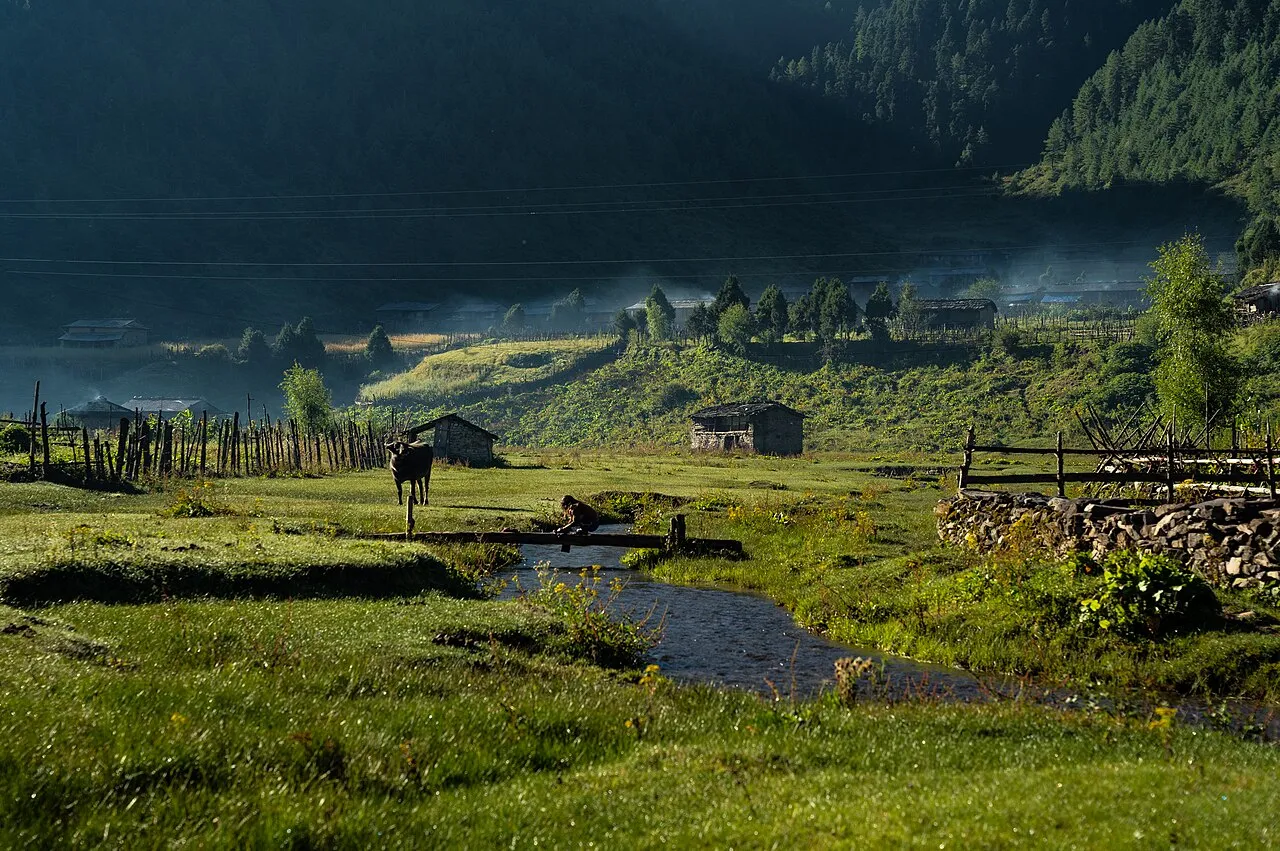
Dhorpatan valley at first light
Gurja Khani — the highest village
The largest and highest Chhantyal village in the Dhaulagiri region, Gurja Khani sits at about 2,650 metres on the flank of Gurja Himal. It was founded in the copper-mining era, when Chhantyal miners and Bishwakarma metalworkers settled there together.
Villages of Myagdi
Villages of Baglung
Across Nepal today
With time and opportunity, many families have moved to Nepal’s towns and cities.
- Kathmandu Valley
- Pokhara
- Kaski
- Rupandehi (Butwal)
- Dang
- Chitwan
Around the world
Like much of Nepal, our younger generations have travelled far for work and study. Chhantyal families are now part of the global Nepali diaspora, settled across these countries and beyond.
- Qatar
- United Arab Emirates
- Saudi Arabia
- Kuwait
- Malaysia
- United Kingdom
- United States
- Japan
- South Korea
- Australia
- Portugal
- Hong Kong
- Belgium
Don’t see your village or city? Help us complete the picture through the Connect page.
The community today
For all our long history, the Chhantyal are a small people. By Nepal’s most recent national census we numbered around twelve thousand — spread far beyond the home valleys, yet most concentrated still in Baglung and Myagdi.
- 11,810 people (2011 census)
- 4,283 recorded language speakers
- 43 districts of Nepal with Chhantyal families
- 72.7% literacy rate (above the national average)
The Chhantyal are officially recognised as one of Nepal’s 59 indigenous nationalities (Adivasi Janajati), and are listed among the country’s “disadvantaged” groups — a status the community’s organisations work to change.
Figures compiled by the Nepal Chhantyal Sangh (Central Committee) from Nepal’s 2011 national census — chhantyalsangh.org
The twelve clans
Chhantyal society is traditionally formed of twelve clans. Marriage customarily took place among them.
- Bhalanja
- Budhathoki
- Dandamare
- Gharabja
- Gharti
- Ghyapchan
- Jhingraja
- Khadka
- Potlange
- Purane
- Singe
- Tathapja
The twelve clan names are confirmed by the Nepal Chhantyal Sangh — chhantyalsangh.org
Living culture
Our heritage lives in the Purkhyauli (ancestral) dance, still performed today; in crafts like the woven Piringo basket and the Reita used for spinning wool; and in a spiritual life that weaves Buddhism together with reverence for ancestors and the natural world.
Purkhyauli dance
Piringo basket
Reita spinning
Watch & listen
A few glimpses of our homeland, customs, and music — shared by community members on YouTube. Press play to watch.
Our villages
Gurja Khani — the largest Chhantyal village
A journey up to Gurja Khani in Myagdi, the highest and largest Chhantyal village in the Dhaulagiri region.
Ghumante · YouTube
Kuine Khani — a Chhantyal village of Myagdi
Everyday life and landscapes of Kuine Khani, one of the old copper-mining settlements of our homeland.
SJM Network · YouTube
Customs & culture
Chhantyal marriage customs
A village vlog documenting the traditions of a Chhantyal wedding in rural Nepal.
Tulendra–Tirpal · YouTube
Songs & music
The Voices of Chhantyal — a music documentary
A documentary following the creation of music in a Chhantyal village in the Dhaulagiri Himalaya — the voices, instruments and songs of the community.
Maïanāda · YouTube
Myagdi Sira — a Salaijo folk song
A Salaijo folk song from the hills of Myagdi, performed by Chhantyal singers.
Naumaya Chhantyal & Mohan Chhantyal · YouTube
Have a video of a festival, dance, or elder’s story? Share it with us through Connect .
This page is a starting point. If you hold family stories, photographs, or knowledge of our traditions, we would love to add them — see Connect.